
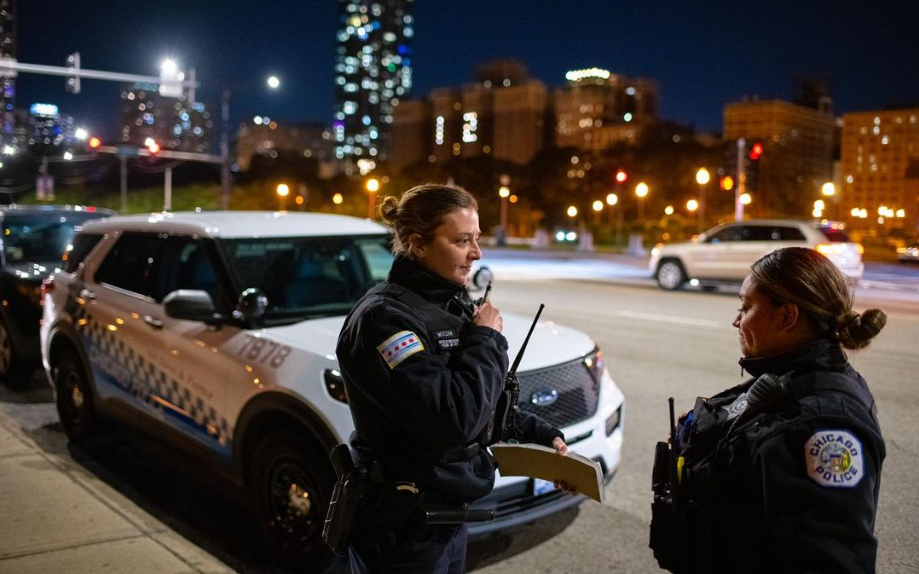
Advancing Community-Focused Policing Project
Advancing Community-Focused Policing Project
“Building community trust is more than just an objective, it is at the core of the Chicago Police Department’s efforts to bolster safety throughout our city. Policing and community must be intertwined to achieve true safety in partnership with the residents we serve.”
-Superintendent Larry Snelling, Chicago Police Department
What is Community Policing?
Community Policing is a proven approach to policing that prioritizes building relationships of trust and collaboration between officers and the communities they serve so that, working together, they can create safer communities.
Project Background and Final Reports
In April 2024, the Chicago Police Department asked Civic Consulting Alliance to conduct an assessment of current community policing operations and develop recommendations for how to operationalize community policing throughout the department. This two-year process included significant city-wide community engagement.
Click here for project background and final reports: https://www.ccachicago.org/community-policing
Stakeholder Engagement Highlights
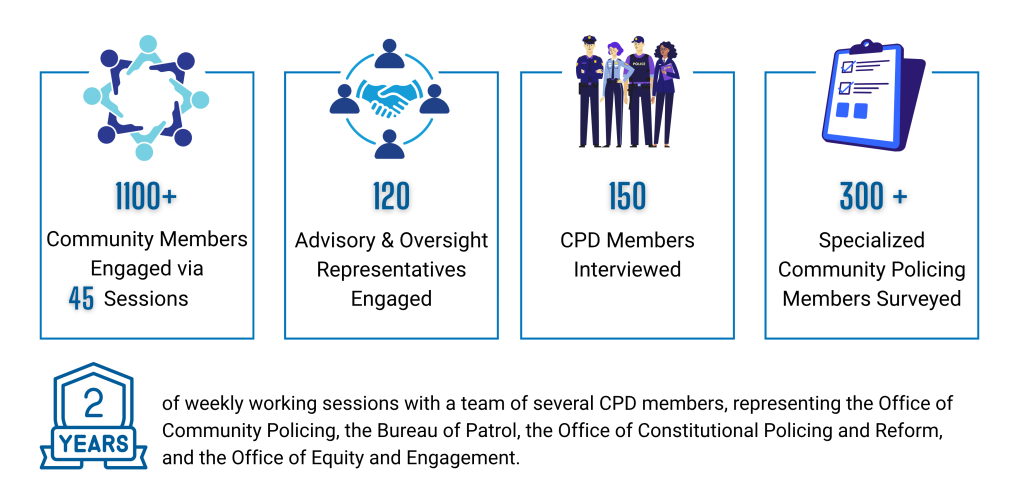
Community Engagement Organizations
The community-based organizations chosen to lead the community engagement were selected based on an open, competitive process. These organizations represent different demographic areas that contribute to the diversity of Chicago:
- YWCA Metro Chicago
- Brave Space Alliance
- Bright Star Community Outreach
- BUILD Incorporated
- Coalition for a Better Chinese American Community
- El Valor
- Target Area Development Corp
- The Resurrection Project
How to Get Involved in Your Community
- Enter your address here to find your district
- Scroll down and click on each district for contact information, beat map, news, and district-specific engagement calendar
- Attend a Beat Meeting: where residents meet with beat officers to discuss community issues and develop solutions
- Join or Form a Block Club: block clubs are groups of neighbors working together to improve the quality of life in their community
- Community Training Observation Days (CTOD): provides residents an opportunity to observe officer training, such as de-escalation techniques, crisis intervention, and simulator-based training
- Provide Public Policy Feedback: community members can review draft directives, such as Use of Force or Search Warrant policies, and submit comments directly online, typically during a 15-day comment period
How to Report a Concern
- Criminal Activity (gangs, narcotics, prostitution), disorder, and/or quality of life concerns including troubled building (abandoned, dilapidated) via CPD’s Community Concern Reporting Portal
- City Services (streetlights, garbage pickup, graffiti) or non-emergency police services, including such as senior well-being checks via Chicago 311 portal
- Police Performance (Complaints or Compliments): COPA Website
Learn More About
- CPD Data, statistics and reports: includes weekly crime statistics by District, annual reports as well as dashboards of complaints filed, consent decree progress and use of force
- Community Policing Advisory Panel (CPAP) Report: provides a comprehensive review of progress made by CPD in strengthening public safety and rebuilding trust through meaningful community engagement.
- CPD Draft Annual Training Plan for 2025: CPD’s Training and Support Group conducts an annual training needs assessment to collect input from stakeholders regarding CPD training priorities. This needs assessment process informs the development of CPD’s annual training plan. Additionally, see here for CPD’s training policy.
- The Consent Decree requires CPD and the City of Chicago to reform training, policies, and practices in a number of important areas, such as use of force, community policing, impartial policing, training, accountability, officer wellness, data and information systems, and more. The goal is to ensure that the CPD performs constitutional and effective policing that keeps both community members and officers safe and restores the community’s trust in the Department.
- The Independent Monitoring Team evaluates the progress and issues public reports on whether the City and CPD are meeting the requirements of the consent decree.